This year sees the centenary of the erection of the Recreation Ground Memorial Gates. One hundred years ago today an estimated five thousand people came to Stowmarket to see the long awaited unveiling of the gates.
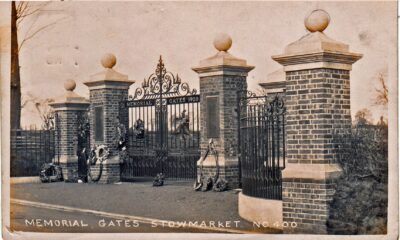
A postcard from April 1921 featuring the newly erected gates
The Grade II listed memorial gates currently act as one of the entrances to our much loved Recreation Ground, however the land only came into public ownership at the end of the WWI. In November 1918 the people of Stowmarket decided to raise a public subscription to purchase what was then known as King’s Meadows, to pay tribute to the locals who lost their lives to war. A Memorial Committee was formed to collect the money to buy the meadow, and in May 1920 the Committee announced that £1,800 was raised to purchase the land, but there was also an additional £100 to pay for Peace Day celebrations, £170 for entertaining the soldiers when they came home, and £30 to serve tea to the elderly. A further £1100 had been donated to the Committee for them to commission some Memorial Gates and a Memorial Shelter.

Bayliss, Jones & Bayliss advert from 1907
The gate design was from an ornamental gates catalogue produced by a Wolverhampton company, Bayliss, Jones & Bayliss. This firm specialised in ironmongery and they produced many beautiful gates that can still be seen all across the UK today. The memorial gates in Stowmarket are hammered wrought iron with the town’s coat of arms on each side of the gates. The six red brick pillars, with ornamental spherical stone headings, that connect the gates and fencing were laid out by town surveyor Mr G. W. Lingwood, and constructed by Messrs O. Seaman and Sons, still a familiar name in this area.
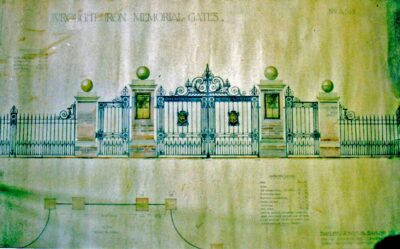
Hand drawn design of the memorial gates
The memorial gates were completed in 1920 and the official opening was held on Sunday February 13th 1921. It was a day of celebration and commemoration. In the morning a ceremony took place at the parish church with attendees from the military, Red Cross, fire service, special constables, town council, Salvation Army, Scouts, Guides, and Boys Brigade, along with people of Stowmarket who had lost loved ones in the war. After the service the congregation walked from the church to the gates on Finborough Road. Cameras from Gaumont Graphic newsreel company filmed the march from the church and the unveiling of the gates for screening in cinemas nationwide. In an article published in The Flyer last year tells us:
“After a service at the Parish Church, the camera is positioned near the entrance to Hillcroft House and the film shows the lengthy procession wend its way along Tavern Street. The camera is repositioned in Finborough Road showing more of the crowd scene and finally at the gates themselves. It was naturally still only a silent movie at that stage so the dignitaries doing their official speeches could only be imagined, however, the film did manage to capture the embarrassing moment during the solemn and ceremonial unlocking and opening the gates. They jammed! At the most critical moment, they would not budge, and much pushing and shoving and head scratching ensued until, to everyone’s relief, they finally opened and everyone cheered.”

A shot from the 1921 newsreel footage of the opening ceremony
The local headmaster Harvey James Joyce had the emotional role of reading the names of the dead, many of whom were boys and men who had been through his school. In a mark of touching respect all of the curtains of Stowmarket households were closed for the day and the Minute guns were fired at intervals all through the afternoon.
Today you can see the names of those lost their lives to war on the memorial tablets. The Lord Lieutenant of Suffolk, Sir T Courtenay Warner, unveiled the WWI names at the 1921 ceremony and after WWII, two tablets were added to the gates, which were unveiled and dedicated on Sunday 12th November 1950 by The Right. Hon the Earl of Stradbroke, The Lord Lieutenant of Suffolk. The only civilian and only woman whose name appears on the gates is that of Rhoda Farrow, who was killed in the 31st January 1941 Stowmarket bombing. You can read more about her story and the bombing on the Stowmarket Local History Group Facebook page.
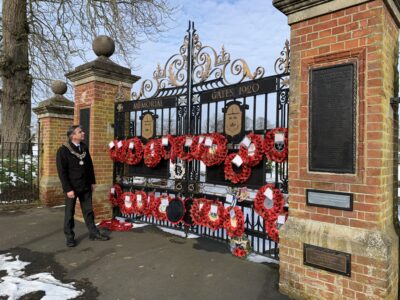
Mayor Keith Scarff
Due to the ongoing coronavirus restrictions today’s centenary of the Memorial Gates unveiling will be muted. This year the gates will be refurbished and further commemorations will take place in November 2021.
This article was informed by articles by Harry Double and Steve Williams, as well as independent research using Grace’s Guide to British Industrial History, and Historic England.